Three Exams, Three Different Career Paths
The Staff Selection Commission (SSC) conducts several recruitment exams for central government ministries, departments and paramilitary forces, and three of the most commonly confused are CHSL, MTS and GD Constable. While all three are conducted by the same commission and are open to a wide pool of candidates, they lead to very different kinds of jobs, require different educational qualifications, and involve different selection stages. Choosing the right one depends on a candidate’s qualification, physical fitness and career preference. All official notifications for these exams are published on ssc.gov.in.
SSC CHSL: Office-Based Clerical Roles
The Combined Higher Secondary Level (CHSL) exam recruits candidates for posts such as Lower Division Clerk, Postal Assistant, Sorting Assistant and Data Entry Operator across various central government offices and departments. As the name suggests, the minimum educational qualification is passing Class 12 (10+2) from a recognised board, making it accessible to candidates who have not yet completed, or do not plan to pursue, a graduate degree.
CHSL Selection Stages
- Tier I — a computer-based objective test covering general intelligence, general awareness, quantitative aptitude and English language.
- Tier II — a further stage that has, in recent cycles, combined objective testing with a descriptive component and, for some posts, a skill or typing test.
CHSL suits candidates looking for a stable, office-based clerical career in central government departments without the requirement of a graduate degree.
SSC MTS: Multi-Tasking Support Staff
The Multi-Tasking Staff (MTS) exam recruits for group C non-technical posts that involve general office support duties such as cleaning, carrying files, gate duty, and other basic office assistance functions across ministries and departments. SSC also uses the same exam cycle to recruit for Havaldar posts in the Central Board of Indirect Taxes and Customs, which involves slightly different duties.
The minimum educational qualification for MTS is passing Class 10, making it the most accessible of the three exams in terms of academic requirement. This makes it a common entry point for candidates who want a central government job immediately after school.
MTS Selection Stages
- Paper I — a computer-based objective test covering numerical and reasoning ability, general awareness and English language.
- Paper II — in recent cycles this has been a descriptive test, though its exact format and whether it is qualifying or counted toward merit should be checked in the current notification, since it has been revised across years.
- Physical requirements — for Havaldar posts specifically, physical standards and a physical efficiency test may apply; regular MTS posts generally do not have a physical test.
SSC GD Constable: Paramilitary and Police Support Roles
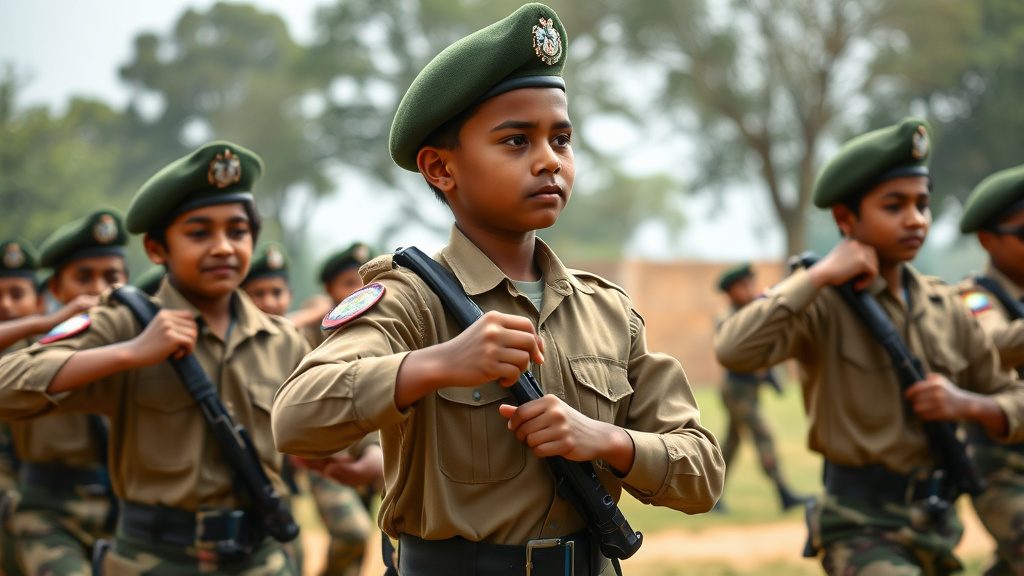
The General Duty (GD) Constable exam is conducted by SSC to recruit constables for central paramilitary and police forces, including forces such as the Central Reserve Police Force, Border Security Force, Central Industrial Security Force and others, along with Rifleman posts in the Assam Rifles. This exam is distinct from CHSL and MTS because it leads to a uniformed, field-based career rather than an office role.
The minimum educational qualification is passing Class 10, similar to MTS, but GD Constable recruitment adds physical and medical standards that are not part of CHSL or MTS selection.
GD Constable Selection Stages
- Computer-based objective test covering general knowledge, reasoning, elementary mathematics and English/Hindi.
- Physical Efficiency Test (PET) and Physical Standard Test (PST) — candidates must meet height, chest and running or physical endurance standards, which can vary by category, gender and the specific force.
- Medical examination — a detailed medical fitness check, since the role is physically demanding.
- Document verification.
Which Exam Suits Which Candidate
- Candidates who have passed Class 12 and prefer an office-based clerical role should focus on CHSL.
- Candidates who have passed only Class 10 and want an office-support role without physical fitness requirements should consider MTS.
- Candidates who have passed Class 10, meet physical and medical standards, and prefer a uniformed field career should prepare for GD Constable.
A useful way to decide is to weigh comfort with physical training and fieldwork against a preference for a desk-based routine, since this is the clearest practical difference between GD Constable and the other two exams.
Common Ground and Key Differences
All three exams share a broadly similar first-stage syllabus of general awareness, reasoning, quantitative or numerical ability and language skills, which means preparation effort for one can partly support preparation for another. What differs is the minimum qualification, the presence or absence of physical standards, and the nature of the job itself — clerical, general office support, or uniformed field duty.
Reservation, age relaxation, application fee and exact vacancy details vary by exam and recruitment cycle, and candidates should always verify these from the specific notification rather than relying on previous years’ figures, since SSC revises these details periodically.
Frequently Asked Questions
Can a candidate who has passed Class 12 apply for SSC MTS or GD Constable? Generally yes, since the minimum qualification for these exams is Class 10 and having a higher qualification does not usually disqualify a candidate, unless the specific notification states an upper qualification limit. This should be confirmed in the notification for the relevant cycle.
Is there an age relaxation for reserved categories in SSC exams? Yes, SSC follows standard government norms for age relaxation for SC, ST, OBC, persons with disabilities, ex-servicemen and other specified categories. The exact number of relaxation years should be checked in the official notification.
Do CHSL, MTS and GD Constable have different application processes? Each exam has its own separate notification, application window and fee structure, even though all are published through ssc.gov.in. Candidates must apply individually to each exam they wish to appear for.